Annual planning is, in essence, a confidence test for business assumptions. The real pressure is not filling in next year’s numbers. It is deciding which assumptions are strong enough to support the business commitments ahead.
As the next planning cycle gets underway, teams are setting growth targets, cost priorities, inventory strategies, capacity plans, and investment decisions. In an environment shaped by economic pressure, shifting demand, and operational uncertainty, the quality of those decisions depends on whether the inputs behind them reflect current business reality.
Better forecasting helps teams test what is supported by live business data, identify what needs to be revalidated, and understand where uncertainty could affect key decisions before the plan is locked in.
Planning confidence starts when assumptions can be tested
A stronger plan is not built by adding another forecast version. It is built by making the assumptions behind the plan easier to test, compare, and align across teams.
A growth target becomes more meaningful when it can be tested against current demand patterns and customer behavior. A capacity plan becomes more credible when it reflects equipment performance, workforce availability, and fulfillment constraints. An inventory strategy becomes more actionable when it accounts for turnover, product availability, and replenishment risk.
When forecasting brings these inputs into the discussion, teams can move beyond setting targets and start validating the conditions required to achieve them.
The most material planning risks often sit inside operations
For operationally complex businesses, the assumptions that matter most often sit close to execution: production performance, available capacity, inventory flow, supplier reliability, and fulfillment constraints.
Manufacturing is one of the clearest examples. A revenue target may look achievable on paper, but its credibility depends on available capacity. That capacity is shaped by OEE, downtime, throughput, changeover, yield, and equipment stability. If these variables are not reflected in the forecast, the annual plan may miss the execution constraints behind the target.
OEE variability affects actual output. Downtime affects production commitments. Throughput instability influences delivery rhythm, inventory strategy, and labor planning. These same signals also shape CapEx decisions, helping leaders determine whether they should expand capacity, optimize existing lines, or first address bottlenecks and utilization issues.
The same logic applies across other industries. Retail teams need product velocity, inventory availability, and promotional impact reflected in the forecast. Supply chain teams need lead time variability, supplier reliability, and fulfillment capacity included in the discussion.
More mature forecasting brings operational reality into the annual plan. It connects what the business wants to achieve with what the business is actually equipped to deliver.
Connected data turns forecasting into a cross-functional planning capability
Forecasting becomes more valuable when teams can see how different business inputs interact.
For example, a manufacturing business may be preparing for higher demand next year. Finance sees the revenue target and cost baseline. Operations sees OEE variability on a critical production line. Inventory sees material constraints. Procurement sees supplier lead times extending.
If these signals remain disconnected, each team plans with only part of the picture. The plan may assume higher output, while actual capacity, material availability, or supplier reliability points to a different reality.
Connected data changes the discussion. Before the plan is finalized, teams can see whether revenue targets, throughput, inventory availability, supplier risk, and fulfillment capacity are aligned. This is how forecasting moves from a finance exercise to a cross-functional planning capability.
AI turns connected signals into earlier risk and scenario visibility
Built on connected data, AI can improve the speed, visibility, and scenario coverage of forecasting.
AI does not replace planning judgment. Its value is in helping teams detect change earlier, test more scenarios, and identify risks before they become performance variances.
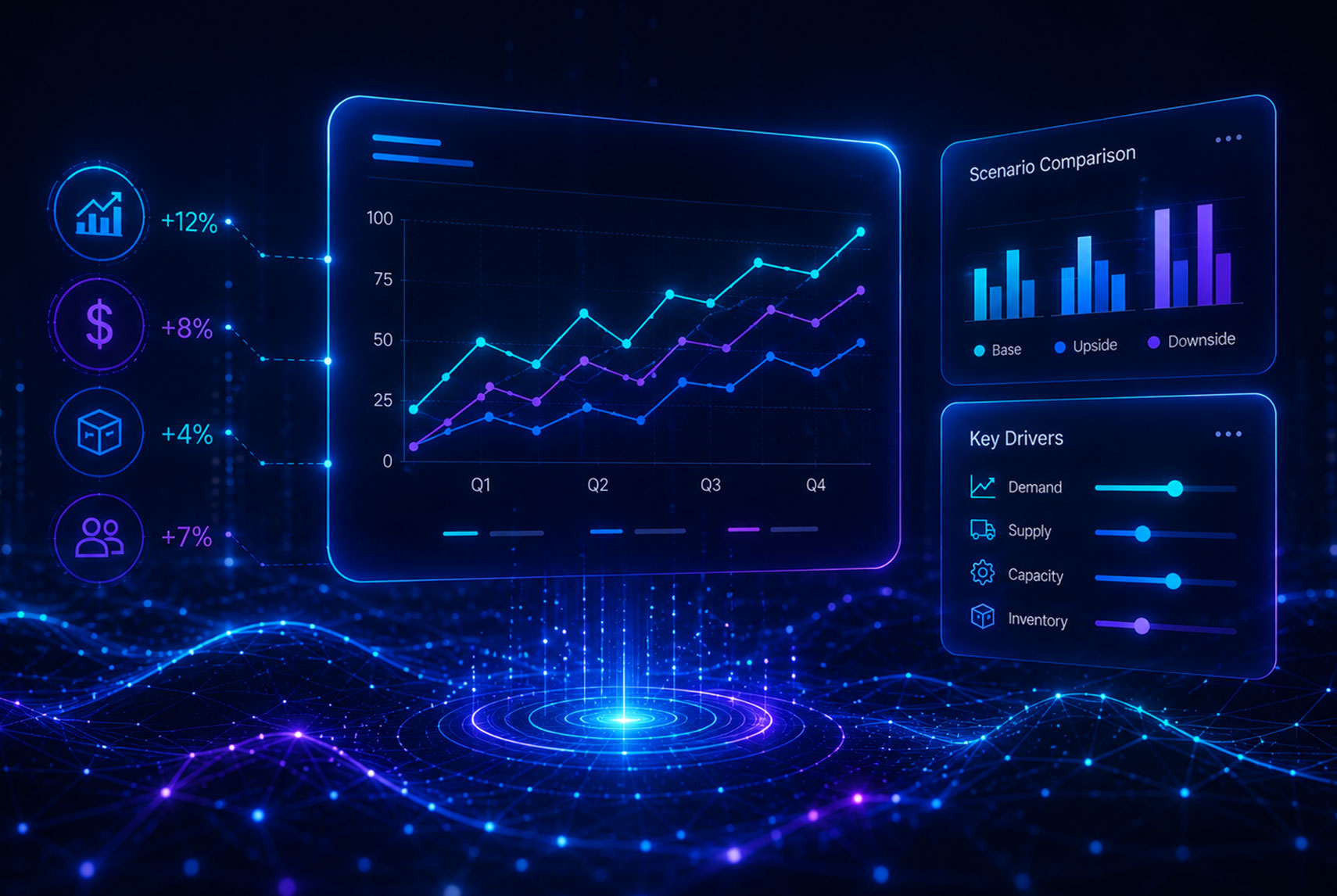
Demand sensing can capture shifts in customer and market signals. Scenario modeling can test different demand, cost, capacity, and supply chain conditions. Predictive forecasting can help identify production constraints, fulfillment risks, inventory exposure, and margin pressure earlier, giving teams more time to adjust before those risks affect performance.
The real business value is not the model itself. It comes from whether forecast outputs enter the planning workflow, helping teams adjust production plans, validate inventory strategy, test CapEx needs, manage supplier risk, and make clearer decisions before commitments are made.
Better forecasting is ultimately about decision confidence
Planning season should not simply create more spreadsheets or more forecast versions. It should help teams build greater confidence in the business decisions they are about to make.
Before finalizing next year’s plan, teams should ask:
- Which assumptions still rely mainly on judgment?
- Which operational signals are missing from the planning discussion?
- Where would stronger visibility matter most: demand, capacity, inventory, margin, or risk?
- Which forecasts would help teams adjust earlier, rather than explain variances after the fact?
Better forecasting moves planning from target setting to decision validation. It helps organizations connect business assumptions to operational reality, turn data foundations into forecasting capability, and embed forecast outputs into the decisions that matter.
The result is a plan that is not only more data-driven, but more defensible. Teams gain a clearer view of what is realistic, what needs attention, and where decisions should be adjusted before commitments are locked in.
Want to explore where better forecasting could strengthen your next planning cycle? Book a 30-minute call with our team.